
13 Top Technology Trends for 2026 and Beyond
AI Becomes Part of Everyday Business
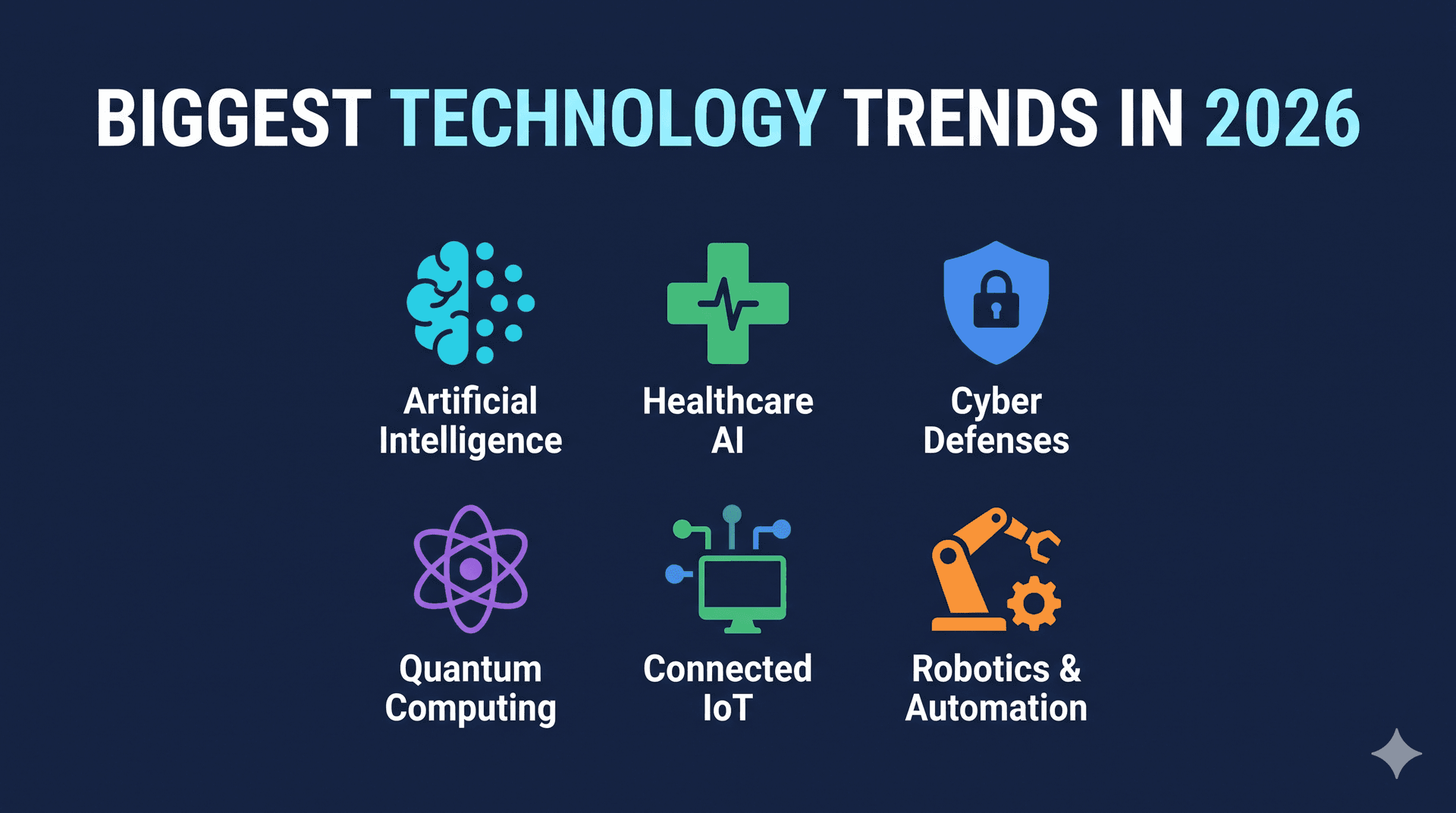
Artificial intelligence, particularly generative AI, is transforming business operations and accelerating early disease detection, making it the biggest technology trend in 2026. Generative AI achieved 53% population adoption within three years, a pace faster than the personal computer or the internet. As of 2026, 88% of organizations leverage AI in at least one business function, according to Stanford’s AI Index. Investment reflects this growth, with US private AI investment reaching $285.9 billion in 2025, significantly outpacing China’s $12.4 billion, as reported by the same index.
Companies like OpenAI, known for ChatGPT, and Google with its Gemini chatbot, have pushed the boundaries of natural-language interaction. Searches for “OpenAI” increased by 2,900% over the past five years, as of October 31, 2026. The next evolution, AI agents, promise to handle multi-step tasks with minimal human intervention, offering potential applications from customer service to content creation and code development. These developments suggest that organizations are moving from considering AI adoption to integrating it deeply into their core operations.
AI Speeds Up Early Disease Detection
AI is also revolutionizing healthcare by enabling earlier disease detection. This innovation is critical for improving survival rates, especially for cancers that are historically difficult to catch early. Researchers and health tech startups are dedicating substantial resources to this area. The US Food and Drug Administration (FDA) listed 1,614 AI-enabled medical devices authorized for marketing in the US as of September 4, 2026. Many of these devices analyze medical images to flag potential signs of disease for medical professionals, indicating a shift from research to regulated, practical diagnostic tools.
Advanced Cyber Defenses and Quantum Progress
Cyber threats are becoming increasingly sophisticated, requiring advanced defensive measures. The World Economic Forum’s Global Cybersecurity Outlook 2026 revealed that 94% of surveyed leaders expect AI to be the primary force shaping cybersecurity. Additionally, 73% of respondents reported being directly affected by cyber-enabled fraud in 2025. Deepfake technology, powered by AI and generative adversarial networks, is making fraud and business email compromise (BEC) scams harder to detect. Searches for “deepfake” were up 1,300% over the past five years, as of October 31, 2026.
However, AI is also being deployed as a powerful defensive tool. AI-driven cybersecurity tools can identify and neutralize attacks faster than human operators, stopping breaches before they escalate. This ongoing arms race emphasizes the need for robust fraud controls and AI-powered defenses.
Quantum Computing Moves Toward Real-World Application
Quantum computing, a concept dating back to the 1980s, is nearing practical application with significant funding increases and new chip designs. Searches for “quantum computing” surged by 650% over the past five years, as of October 31, 2026. Unlike traditional computers that use binary bits, quantum computers use qubits, allowing data to exist in multiple states simultaneously, leading to exponentially faster computation. Investment in quantum startups reached $12.6 billion in 2025, a 6.3-fold increase from 2024, according to McKinsey’s quantum investment chart. IBM’s Nighthawk, a 120-qubit processor, and Google’s Willow chip, which achieved verifiable quantum advantage in October 2025, demonstrate the rapid progress in this field. While broad commercial uses are still years away, this funding jump signals late-stage investment interest.
Connected Ecosystems and Invisible Tech
The Internet of Things (IoT) continues its expansion, creating increasingly connected environments. IoT Analytics estimated 21.1 billion connected IoT devices by the end of 2025, a 14% increase from 18.5 billion in 2024, with projections of 39 billion by 2030. Industries like manufacturing are heavily investing in the Industrial Internet of Things (IIoT) to create “smart factories.” Searches for “IIoT” increased by 54% over the past five years, as of October 31, 2026. Sensors on machinery collect data for analysis by machine learning platforms, improving efficiency, reducing waste, and predicting maintenance needs. IoT devices also underpin smart cities, gathering data from infrastructure to enhance urban efficiency and safety. This consistent growth in connected devices ensures a continuous data stream for AI and edge computing.
Ambient Computing Enables Nearly Invisible Tech
Building on IoT, ambient computing aims for a future where technology operates seamlessly in the background with minimal human interaction. This AI-driven network of devices and software interprets data from physical devices like smart thermostats and wearables to make autonomous decisions. Examples include voice assistants and smart home devices that learn user routines. Beyond consumer applications, factories use ambient tech for automated machine maintenance scheduling, and retail might see shelf sensors automatically reorder inventory. As this technology matures, privacy and security concerns remain paramount, highlighting its role as a design goal for intuitive, unobtrusive technology.
Robots and Robotic Process Automation Gain Ground
The integration of automation is growing, with Robotic Process Automation (RPA) being a key area of executive excitement. RPA involves training software to automate mundane, repetitive tasks, freeing up human talent for higher-value work. This includes copying data, extracting information, booking appointments, and monitoring compliance. UiPath, a leading RPA vendor, has seen its search volume increase by 285% over the past five years, as of October 31, 2026.
Physical robots are also rapidly expanding their presence. Factories worldwide operated a record 5 million industrial robots in 2025, an increase of 9% from the previous year, according to the International Federation of Robotics (IFR) World Robotics 2026 report. Installations of new industrial robots reached over 600,000 in 2025, an 11% rise from 2024. China led installations in 2024 with 295,000 units, accounting for 54% of the global total, as per the IFR’s World Robotics 2025 report. Professional service robot sales also grew, reaching nearly 200,000 units in 2024, up 9%. Figure’s $1 billion Series C funding round in 2025, valuing the company at $39 billion, along with a 2,400% increase in searches for “humanoid robots” over the past five years (as of October 31, 2026), indicates substantial investment and interest in the robotics sector.
Automation, Healthcare, and Wearable Innovation
FemTech Looks to Reform Traditional Women’s Healthcare
The FemTech sector, encompassing technology for women’s health, is poised for significant expansion. Searches for “FemTech” have grown by 100% over the past five years, as of October 31, 2026. Virtual clinics offer increased access to care via telemedicine, while wearables provide data for better health assessment. Maven Clinic, which became the first female-focused health startup to reach a $1 billion valuation in 2021, exemplifies this trend by providing a digital health platform for women and families. Searches for “Maven Clinic” increased by 400% over the past five years, as of October 31, 2026. This suggests that FemTech is an early-stage market with considerable growth potential.
Wearable Devices Get Sleeker & Smarter
The wearables market continues to grow, albeit slowly, with worldwide shipments projected to increase by 1.7% to approximately 625 million units in 2026, according to IDC. Beyond basic sleep and step tracking, new devices are offering more advanced features. Smart rings, for example, incorporate near-field communication for payments, door unlocking, and comprehensive health tracking. Searches for “smart ring” were up 1,050% over the past five years, as of October 31, 2026. This trend suggests that future growth in wearables will likely come from innovative form factors like rings and smart glasses, rather than just smartwatches.
Extended Reality Shifts From Headsets to Smart Glasses
Extended Reality (XR), an umbrella term for augmented, virtual, and mixed reality, is undergoing a significant transition. Searches for “extended reality” increased by 212% over the past five years, as of October 31, 2026. The XR market grew by 44.4% in 2025, driven by smart glasses, with IDC forecasting 33.5% growth in 2026. While Meta held 72.2% of the XR market in 2025, its Quest headset shipments declined by 42.3%. IDC anticipates that display glasses will surpass VR and MR headsets in sales by 2027. Searches for “smart glasses” were up 750% over the past five years, as of October 31, 2026. This shift indicates a move from entertainment-focused headsets towards everyday, hands-free applications, particularly in B2B sectors like medical training, and automotive and manufacturing industries for intricate process training and error prevention.
Data Transformation and Simplified Development
Edge Computing Transforms How Enterprises Use Data
Companies are substantially increasing their investment in edge computing, with spending reaching $265 billion in 2025 and projected to nearly double by 2029, according to IDC. As data-intensive technologies like IoT, remote health monitoring, and remote work proliferate, the demand for increased processing power is surging. Edge computing addresses this by processing data closer to its source, reducing latency and saving bandwidth. Searches for “edge computing” rose by 137% over the past five years, as of October 31, 2026. This approach allows enterprises to reduce reliance on expensive cloud computing services and enable faster decision-making. The growing reliance on AI further fuels edge computing, as AI/ML systems require more data analysis and computation at the edge to achieve their full potential. For instance, self-driving cars process sensor data instantly at the edge, and security cameras use edge AI to detect suspicious activity in real-time. Searches for “edge AI” spiked by 3,700% over the past five years, as of October 31, 2026, indicating a significant shift towards localized AI workloads.
More Developers and Non-Developers Use Low/No Code Tools
Low-code and no-code (LCNC) software programs are becoming essential for accelerating software development. These visual, AI-powered tools allow developers to streamline or bypass the process of writing extensive lines of code, significantly speeding up software creation. LCNC solutions also empower non-developers to build applications due to their user-friendly design. Low-code application platforms (LCAPs), offering component-based structures and pre-defined templates, are central to this trend. Mendix, acquired by Siemens in 2018, is a prominent low-code platform, with searches for “Mendix” up 7% over the past five years, as of October 31, 2026. As more individuals build applications using LCNC tools, these platforms are expected to become more widespread across enterprises.
What’s Next for Technology?
The technology landscape for 2026 and beyond is characterized by rapid evolution across multiple sectors. AI, as the dominant force, is not only transforming everyday business and healthcare diagnostics but also influencing advancements in cybersecurity, robotics, and edge computing. Robotics, both in software automation and physical industrial applications, continues to see record investment and deployment. The shift towards more integrated and invisible technologies, from ambient computing to sleek wearable devices and smart glasses for extended reality, indicates a move towards more seamless human-computer interaction.
The increasing need for efficient data processing is driving significant investment in edge computing, while low/no-code tools are democratizing software development. These trends collectively suggest a future where technology is more embedded, intelligent, and accessible, offering both opportunities and challenges for investors, founders, and enterprise strategy teams. The data from various reports and search trends as of October 31, 2026, confirm these areas as pivotal for the next wave of technological innovation.
Advertisement