
Mastering Online Regex Testers: A Beginner's Guide to Debugging Your Patterns
Regular expressions (regex) are powerful tools for pattern matching within text, but crafting and debugging them can be challenging. An online regex tester provides an interactive environment to write, test, and refine your patterns in real time, making the debugging process significantly more efficient. This guide will walk you through the essentials of using these testers, provide a cheat sheet of 25 practical regex examples for common use cases like email, phone numbers, and URLs, and offer tips to master your pattern-matching skills.
What Are Regular Expressions?
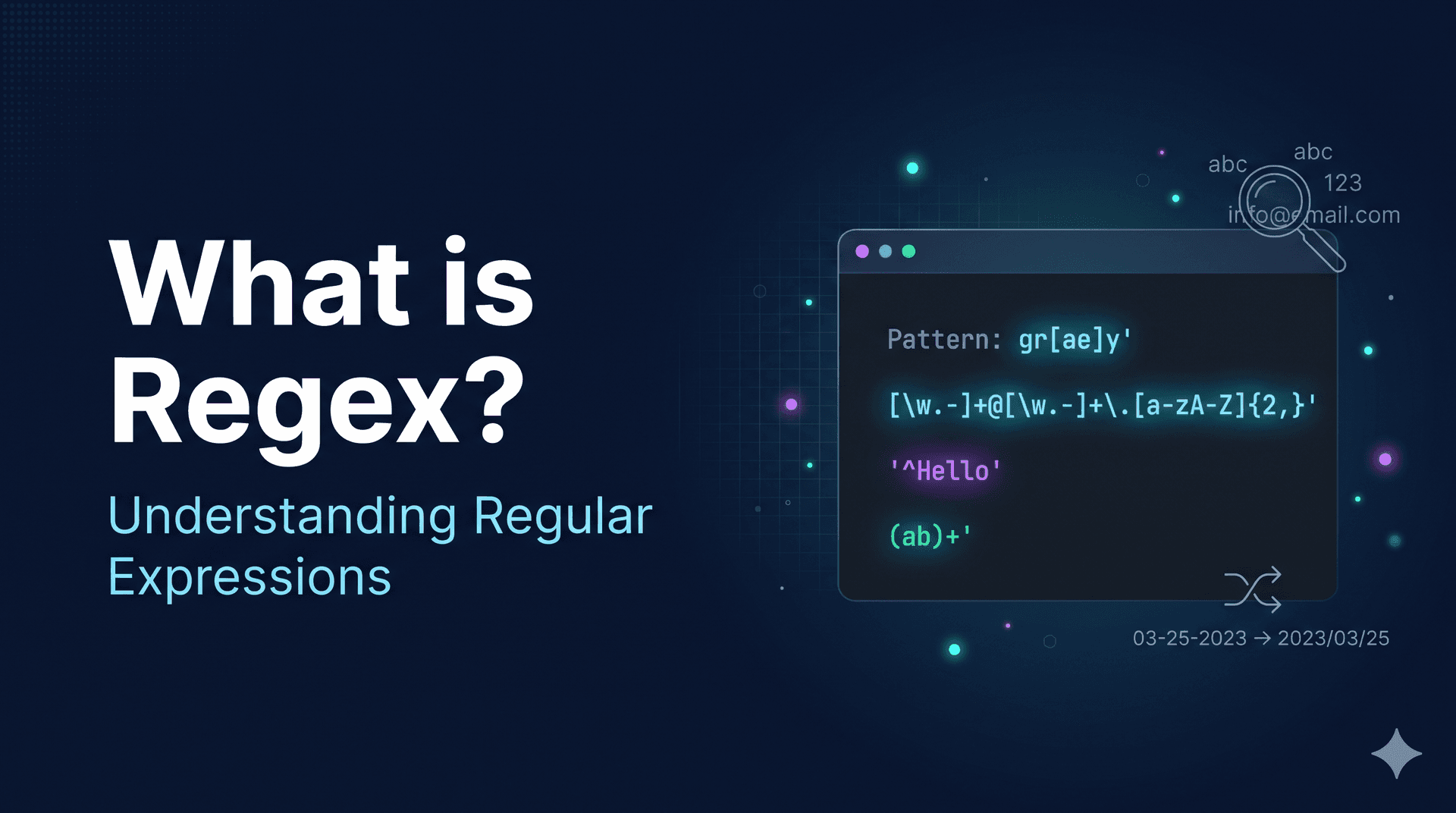
Regular expressions, often shortened to regex or regexp, are sequences of characters that define a search pattern. They are widely used in programming languages, text editors, and command-line tools for tasks such as data validation, string searching, and text manipulation. Instead of matching exact strings, regex allows you to define flexible rules to find variations of a pattern, making them incredibly versatile for handling diverse textual data.
For instance, if you need to find all email addresses in a document, manually searching for every possible combination of letters, numbers, and symbols would be impossible. A single regex pattern, however, can identify all valid email formats.
Why Use an Online Regex Tester?
Online regex testers are indispensable for anyone working with regular expressions, especially beginners. They offer several key advantages:
- Real-time Feedback: As you type your regex pattern and test string, the tool immediately highlights matches, giving you instant visual confirmation of whether your pattern is working as intended.
- Debugging and Refinement: When a pattern doesn't yield the expected results, testers help you pinpoint where the regex is failing. You can incrementally build complex patterns, testing each component along the way.
- Explanation of Matches: Many testers provide detailed breakdowns of how each part of your regex contributes to a match, which is invaluable for understanding complex patterns.
- Flag Management: You can easily toggle different regex flags (e.g., case-insensitive, global, multiline) to see how they affect your matches without modifying your code.
- Language-Specific Support: Some advanced testers allow you to select a specific regex engine (e.g., JavaScript, Python, PHP, PCRE) to ensure your pattern behaves consistently across different programming environments.
Our dedicated Regex Tester tool is an excellent resource for experimenting with the examples in this guide and debugging your own patterns.
Core Regex Syntax Elements
Before diving into practical examples, understanding the fundamental building blocks of regex is crucial. Here's a brief overview:
Literal Characters
Most characters match themselves directly. For example, abc will match the exact string "abc".
Metacharacters
These are special characters with specific meanings:
.(dot): Matches any single character (except newline).\d: Matches any digit (0-9).\D: Matches any non-digit.\w: Matches any word character (a-z,A-Z,0-9, underscore).\W: Matches any non-word character.\s: Matches any whitespace character (space, tab, newline, etc.).\S: Matches any non-whitespace character.
Quantifiers
These specify how many times a character or group should appear:
*: Matches zero or more occurrences. (e.g.,a*matches "", "a", "aa", etc.)+: Matches one or more occurrences. (e.g.,a+matches "a", "aa", etc., but not "")?: Matches zero or one occurrence. (e.g.,colou?rmatches "color" or "colour"){n}: Matches exactlynoccurrences. (e.g.,\d{3}matches "123" but not "12"){n,}: Matchesnor more occurrences. (e.g.,\d{2,}matches "12", "123", etc.){n,m}: Matches betweennandmoccurrences (inclusive). (e.g.,\d{3,5}matches "123", "1234", "12345")
Character Sets (Brackets)
[...]: Matches any one of the characters inside the brackets.
[aeiou]: Matches any vowel.[0-9]: Matches any digit (same as\d).[A-Za-z]: Matches any uppercase or lowercase letter.[^abc]: Matches any character *not* 'a', 'b', or 'c'. (^inside brackets negates the set)
Anchors
These assert positions in the string:
^: Matches the beginning of the string.$: Matches the end of the string.\b: Matches a word boundary (e.g.,\bword\bmatches "word" but not "swordfish").\B: Matches a non-word boundary.
Groups and Alternation
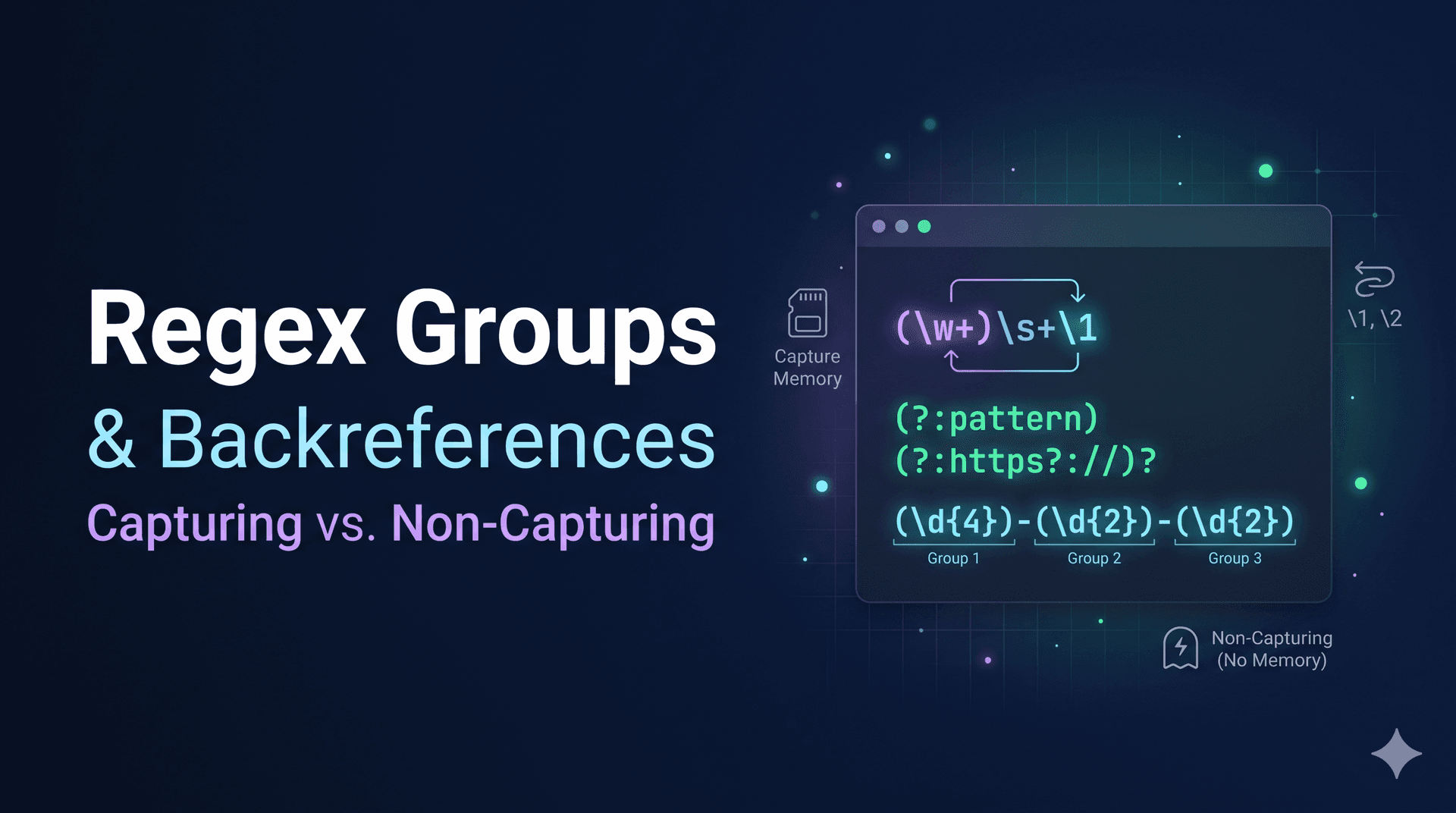
( ): Creates a capturing group, allowing you to treat multiple characters as a single unit or extract specific parts of a match.|: Acts as an OR operator, matching either the pattern before or after it. (e.g.,cat|dogmatches "cat" or "dog")
Escaping Special Characters
If you need to match a metacharacter literally (e.g., a dot . or a question mark ?), you must escape it with a backslash: \., \?.
25 Practical Regex Examples for Common Tasks
Here's a cheat sheet of practical regex patterns. Use an online tester to experiment with these patterns and see how they work with different input strings.
| # | Pattern | Description | Example Match | Example No Match |
|---|---|---|---|---|
| 1 | ^Hello$ |
Matches "Hello" exactly from start to end of the string. | Hello |
Hi, Hello there! |
| 2 | \d{3}-\d{2}-\d{4} |
Matches a Social Security Number-like format (e.g., 123-45-6789). | 123-45-6789 |
12345-6789 |
| 3 | \bcat\b |
Matches the whole word "cat", not part of another word. | The cat sat. |
catastrophe |
| 4 | [0-9]+ |
Matches one or more consecutive digits. | 12345 |
abc |
| 5 | [A-Za-z]+ |
Matches one or more consecutive letters (case-insensitive). | HelloWorld |
H3lloWorld |
| 6 | ^[a-zA-Z0-9._%+-]+@[a-zA-Z0-9.-]+\.[a-zA-Z]{2,}$ |
Matches a common email address format. | user@example.com |
user@example |
| 7 | ^\d{4}-\d{2}-\d{2}$ |
Matches a YYYY-MM-DD date format exactly. | 2023-10-26 |
2023/10/26 |
| 8 | ^(https?://)?([\da-z\.-]+)\.([a-z\.]{2,6})([/\w \.-]*)*/?$ |
Matches a URL, optionally with http/https and a path. | https://www.example.com/path |
example |
| 9 | ^(\+\d{1,3}\s?)?(\(?\d{3}\)?[-.\s]?\d{3}[-.\s]?\d{4})$ |
Matches a common US or international phone number format. | +1 555-123-4567 |
55512345678 |
| 10 | ^[a-fA-F0-9]{6}$ |
Matches a 6-digit hexadecimal color code (without # prefix). | A3B2C1 |
G12345 |
| 11 | ^#([a-fA-F0-9]{6}|[a-fA-F0-9]{3})$ |
Matches a 3 or 6 digit hex color with a '#' prefix. | #FF00FF |
FF00FF |
| 12 | \d{1,3}\.\d{1,3}\.\d{1,3}\.\d{1,3} |
Matches a basic IPv4 address format. | 192.168.1.1 |
192.168.1 |
| 13 | <[^>]*> |
Matches a basic HTML tag (e.g., <p>, <div>). | <p> |
<p |
| 14 | [aeiouAEIOU] |
Matches any single vowel (case-insensitive). | apple |
rhythm |
| 15 | [^0-9a-zA-Z] |
Matches any single character that is not alphanumeric. | !@# |
abc123 |
| 16 | \s+ |
Matches one or more consecutive whitespace characters. | hello world |
helloworld |
| 17 | (red|blue|green) |
Matches "red", "blue", or "green". | The sky is blue. |
The sky is yellow. |
| 18 | \$(?:\d{1,3}(?:,\d{3})*|\d+)(?:\.\d{2})?\b |
Matches common currency format (e.g., $1,234.56 or $50). | $1,234.56 |
$123.4 |
| 19 | \w{5,} |
Matches a word with 5 or more word characters. | programming |
short |
| 20 | ^[A-Z][a-z]+$ |
Matches a single word starting with an uppercase letter, rest lowercase. | John |
john |
| 21 | ^\s+|\s+$ |
Matches leading or trailing whitespace. (Often used with replace, not just match). | " text " |
"text" |
| 22 | \b\w{3}\b |
Matches any complete 3-letter word. | The cat sat. |
The dog sat. |
| 23 | ^[Yy]es|[Nn]o$ |
Matches "Yes", "yes", "No", or "no" at start/end of line. | yes |
maybe |
| 24 | ([A-Za-z]+)\s(\d+) |
Captures a sequence of letters, followed by a space, then digits. | Item 123 |
Item123 |
| 25 | \b[a-z]{5}\b |
Matches any five-letter word composed of lowercase letters. | world |
Earth |
Tips for Effective Regex Debugging
While online testers simplify the process, mastering regex debugging requires a strategic approach:
- Start Simple, Build Incrementally: Don't try to write the entire complex pattern at once. Start with a small part, verify it works, then add more components.
- Use Specific Test Data: Provide a variety of test strings: strings that should match, strings that should partially match, and strings that should not match at all. This helps validate your pattern's robustness.
- Understand Greedy vs. Lazy Quantifiers: By default, quantifiers (
*,+,{n,m}) are "greedy," meaning they try to match as much as possible. Adding a?after a quantifier makes it "lazy," matching as little as possible. For example,<.*>(greedy) on "<b>bold</b>" matches "<b>bold</b>", while<.*?>(lazy) matches "<b>" and "</b>" separately. - Leverage Capture Groups: Use parentheses
( )to isolate and extract specific parts of a match. This is crucial for data extraction and for understanding which part of a complex pattern is succeeding or failing. - Pay Attention to Flags: Remember that flags like 'global' (find all matches, not just the first), 'case-insensitive', and 'multiline' significantly alter how a pattern behaves. Ensure the flags in your online tester match your intended application environment.
- Read Error Messages (if any): Some advanced testers provide syntax error messages for malformed regex, which can guide your corrections.
Key Takeaways
Mastering regular expressions is a valuable skill for any developer or IT professional, and online regex testers are your best allies in this journey. By understanding the core syntax, practicing with diverse examples, and employing effective debugging strategies, you can confidently craft patterns to validate data, extract information, and manipulate text with precision. Don't shy away from complex patterns; break them down, test incrementally, and leverage your online tools to conquer any textual challenge.
Advertisement