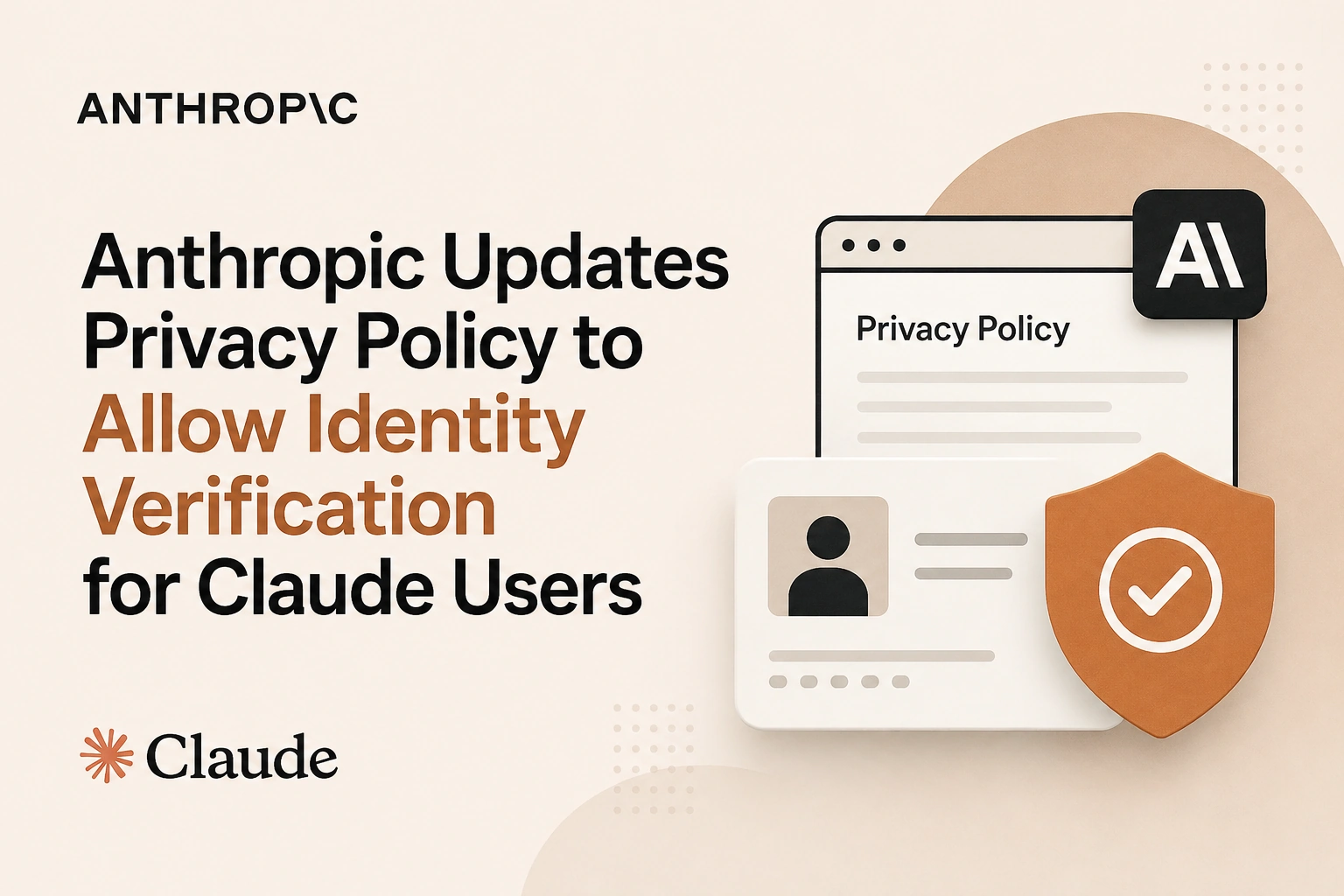
Anthropic Updates Privacy Policy to Allow Identity Verification for Claude Users
Anthropic has quietly but significantly revised its privacy policy to give itself the ability to verify the identity of consumer-level Claude users. The updated terms, set to take effect on July 8, 2026, state that the company may request identity checks in certain situations, though it stops short of detailing precisely what circumstances would trigger such a review.
According to the new policy language, when a verification is requested, the company may collect a range of sensitive personal data. This could include a photograph or scan of a government-issued ID, the personal details shown on that document such as birth date and ID number, a photo or video of the user's face, and facial geometry templates — data that qualifies as biometric information under the laws of several jurisdictions. The outcome of the verification process itself would also be stored.
The stated justification from Anthropic is safety and security. The company says such checks may be conducted to help maintain the integrity of its services, though the policy does not spell out what penalties, if any, users would face by declining to comply. Legal observers note that this ambiguity may be deliberate, since identity and age verification laws differ substantially from one country or US state to another, and enforcement responses would likely need to match local requirements.
Importantly, this revised policy only applies to individual consumer subscribers — those on Free, Pro, and Max plans. Customers accessing Claude through commercial arrangements, including Team, Enterprise, and API tiers, are explicitly excluded from its scope.
The move arrives against a backdrop of fast-proliferating digital safety legislation aimed at shielding minors. In the United States alone, more than two dozen state-level laws now address online safety for children, and several specifically name AI chatbots or require that age verification responsibilities fall on the platforms themselves rather than on app stores. Comparable legislative efforts are advancing in Australia, Brazil, the European Union, India, South Korea, and the United Kingdom.
But child protection may not be the only driver behind the policy change. Anthropic has previously spoken out about the threat of model distillation — a process by which rival AI developers extract knowledge from an existing model to train their own systems. Although Claude is not officially available in countries like China, Russia, and Iran, users in those regions may circumvent restrictions through account sharing or proxy services. Identity verification could serve as an additional layer of access control, making it harder for sanctioned users to exploit loopholes.
The timing of the policy revision is notable: it was published one day before Anthropic launched its Fable 5 and Mythos 5 models, both of which were subsequently disabled to comply with a US government export control directive. Anthropic had not responded to press inquiries about the policy change by the time of publication.
Advertisement