Global Poll Finds China Overtaking the US as Perceived AI Superpower, with American Confidence Declining
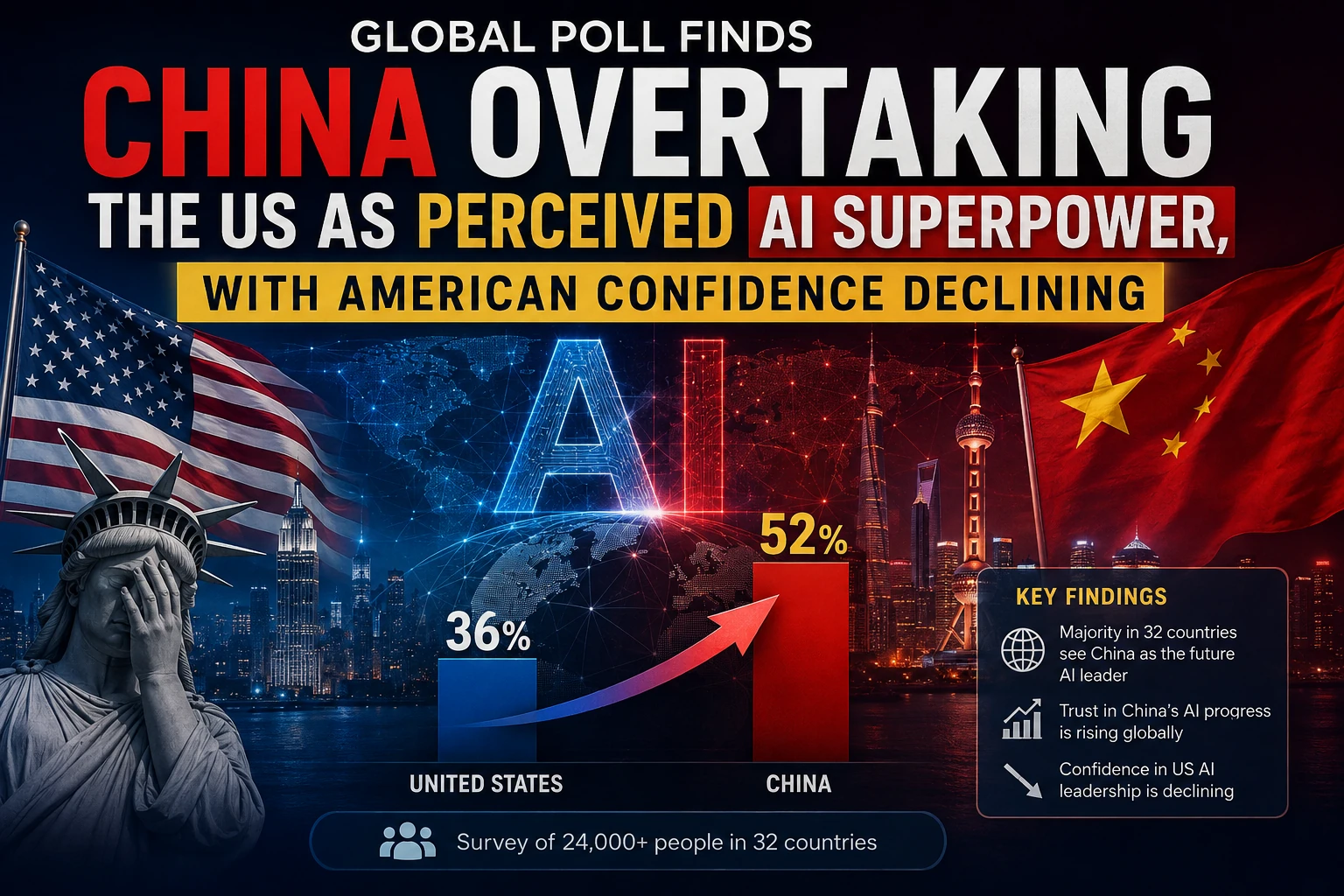
A sweeping international survey has delivered an uncomfortable finding for those who assume US technological dominance in artificial intelligence is self-evident: most of the world no longer agrees. The poll, conducted by UK-based research firm Public First and covering more than 18,000 respondents across 15 countries, found that majorities in eleven of those nations — including close American allies such as France, Canada, and the United Kingdom — now view China as the world's leading AI superpower, not the United States.
The United States still holds a perceived lead among its own citizens and in a handful of Asia-Pacific nations. Slim majorities of respondents in Japan, India, and Vietnam still see the US as dominant. But in Germany, fewer than one in four people shared that view, suggesting that even among historically aligned Western democracies, confidence in American AI leadership has eroded sharply. The findings arrive at a moment when the US government is actively debating how much to regulate AI and how aggressively to restrict rival nations' access to American-developed models.
Beyond questions of global standing, the survey tracked shifts in how Americans themselves feel about AI over a three-year period. The results paint a picture of declining optimism. In 2024, Americans who believed AI would make society better outnumbered skeptics by five percentage points. By 2026, that balance had flipped: more Americans now expect AI to make things worse for society than better. Confidence in AI's personal benefits has also compressed significantly, falling from a net positive of fifteen points in 2024 to just five points today. Expectations for future generations swung from mildly positive to slightly negative over the same period.
The shift is most dramatic among young adults. Americans aged 18 to 24 — who might be expected to embrace new technology — moved from a modest net positive view of AI's societal impact in 2025 to a net negative of thirteen points in 2026. Young people in the United Kingdom showed a similar trajectory. By contrast, respondents in Singapore and India remained broadly optimistic, reflecting a pattern in which countries earlier in their adoption curve tend to view the technology with more enthusiasm.
American concerns cluster around three areas: misinformation and deepfakes, job displacement, and the resource demands of AI infrastructure. Worries about AI's energy and water consumption have grown especially fast — rising from 52 percent of respondents in 2024 to two-thirds in 2026. Community resistance to data centers has become a political flashpoint in multiple US states, with local elected officials facing backlash, recall campaigns, and in at least one case, threats of violence after approving large data center projects.
The labor anxiety is particularly acute among younger workers, shaped in part by prominent warnings from AI company executives themselves. Anthropic CEO Dario Amodei has publicly stated that AI could eliminate half of entry-level white-collar jobs within five years. While such projections remain contested among economists, they have clearly landed with force among workers who expect to spend decades in those roles.
The political dimension of the findings is not lost on Washington. The survey underscores a tension at the heart of US AI policy: too much regulation risks slowing innovation at a moment when China is perceived to be closing the gap, while too little may deepen public distrust and social disruption. Former White House AI policy lead David Sacks has cautioned against heavy-handed oversight, warning that regulatory frameworks modeled on pharmaceutical approval processes could hand China a decisive advantage. Meanwhile, President Trump has publicly insisted the US remains far ahead, even as the polling data suggests much of the world has drawn a different conclusion.
Advertisement