
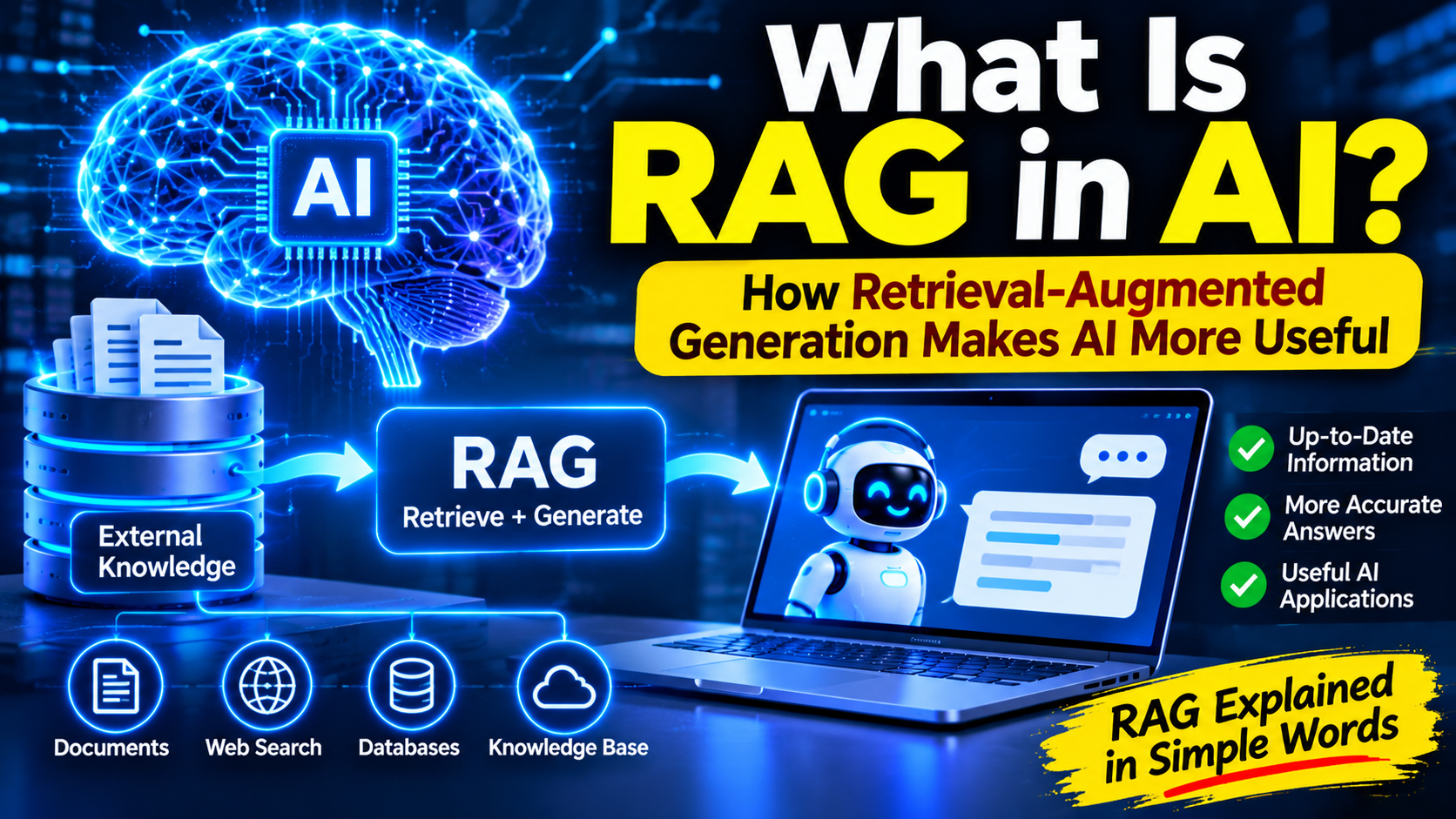
What Is RAG in AI? How Retrieval-Augmented Generation Makes AI More Useful
What Is RAG in AI? How Retrieval-Augmented Generation Makes AI More Useful
Artificial intelligence models can generate explanations, summaries and answers, but they may not always have access to the latest or most relevant information.
Retrieval-Augmented Generation, or RAG, is a technique designed to improve AI responses by connecting a language model to an external knowledge source.
It is becoming an important approach for businesses that want AI applications to answer questions using their own documents and data.
What Is Retrieval-Augmented Generation?
RAG combines two processes: information retrieval and text generation.
First, the system searches a collection of relevant information. It then provides selected results to an AI model, which uses that context to generate an answer.
For example, a company could build an internal assistant that searches employee policies and answers questions using approved company documents.
How Does RAG Work?
A typical RAG application follows these steps:
Collect data: Gather documents, manuals, PDFs or other approved sources.
Prepare information: Extract text and divide it into smaller sections called chunks.
Create embeddings: Convert text into numerical representations that help identify related information.
Store data: Save the embeddings and associated content in a searchable database.
Retrieve results: Search for sections relevant to a user's question.
Generate an answer: Give the retrieved information to the language model as context.
The quality of the final answer depends on both the retrieval process and the language model.
Why Do Businesses Use RAG?
Internal Knowledge Assistants
Employees can ask questions about company documents without manually searching through multiple files.
Customer Support
Support systems can retrieve information from product manuals, help articles and approved documentation.
Research Applications
RAG can help organise large collections of reports, articles and technical documents.
Developer Documentation
Developers can build assistants that search project documentation and explain relevant code or configuration details.
Benefits of RAG
RAG can connect an AI model to information that was not included in its original training data.
It can also make it easier to update a knowledge base without retraining the entire model. When sources are managed properly, the application can show which documents supported an answer.
Challenges Developers Should Understand
RAG does not automatically eliminate incorrect AI responses.
Poor-quality documents, weak search results, outdated information and poorly selected text chunks can all reduce accuracy.
Security is also important. A RAG application must check user permissions before retrieving private documents. Otherwise, it could expose information to someone who should not have access.
RAG vs Fine-Tuning
RAG gives a model relevant information at the time of a question. Fine-tuning changes a model's behaviour by training it further on selected examples.
RAG is often useful when information changes regularly. Fine-tuning may be more appropriate when developers need to adapt a model's style, behaviour or specialised task performance.
Some applications combine both approaches.
Final Thoughts
RAG is an important technique for building practical AI applications that work with business knowledge and changing information.
Its success depends on reliable data, good retrieval, strong access controls and careful evaluation. When these elements are designed properly, RAG can make AI assistants more useful and relevant.
Advertisement