AI Agents in 2026: How Autonomous AI Is Changing the Future of Work
AI Agents in 2026: How Autonomous AI Is Changing the Future of Work
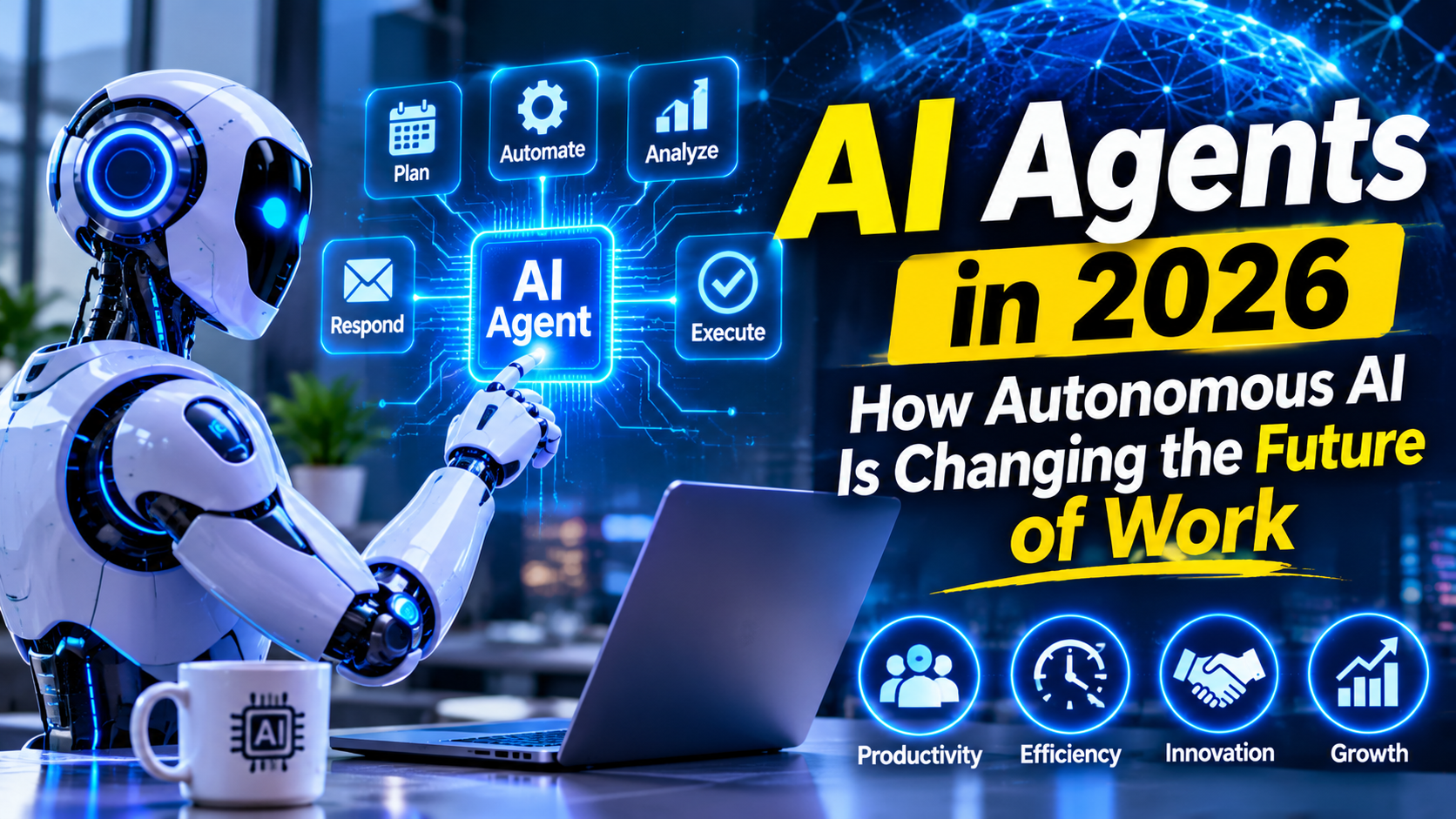
Artificial intelligence is evolving beyond answering questions and generating text. A growing area of development is AI agents: systems designed to understand goals, plan actions and complete tasks using connected digital tools.
Unlike a traditional chatbot that mainly responds to individual prompts, an AI agent can work through multiple steps to achieve a defined objective.
What Are AI Agents?
An AI agent is a software system that uses artificial intelligence to make decisions and perform tasks within a given set of instructions and permissions.
For example, a business could use an AI agent to review incoming customer requests, find relevant information, prepare a response and send the draft to a human employee for approval.
Depending on its design, an agent may interact with websites, databases, calendars, APIs and business applications.
How Do AI Agents Work?
Most AI agent systems combine several capabilities:
Understanding: Interpret the user's goal and available information.
Planning: Break a larger task into smaller steps.
Tool usage: Access approved software, APIs and data sources.
Execution: Perform the planned actions.
Review: Check results and decide whether another step is needed.
Some systems can also remember task context during a workflow, helping them complete longer activities.
Where Can Businesses Use AI Agents?
AI agents can support different business operations.
Customer Support
Agents can classify customer questions, retrieve relevant information and prepare responses for support teams.
Software Development
They can help developers investigate bugs, suggest code changes, generate tests and review documentation.
Marketing
Marketing teams can use agents to organise research, prepare campaign drafts and analyse performance information.
Office Productivity
Agents can assist with scheduling, document preparation, data organisation and repetitive administrative tasks.
Benefits of AI Agents
AI agents can reduce repetitive work, speed up multi-step processes and help employees focus on decisions that require human judgement.
They can also connect different tools into a single workflow, reducing the need to manually move information between applications.
Risks and Limitations
Autonomous systems are not always accurate. An agent may misunderstand instructions, use incorrect information or take an action that was not intended.
Businesses should therefore apply access controls, activity logs, human approval for important actions and limits on what an agent can change.
Sensitive information should only be shared with systems that have appropriate privacy and security protections.
The Future of AI Agents
AI agents could become an important part of business software, but their value will depend on reliability, transparency and responsible deployment.
The most effective approach is to start with clearly defined tasks, measure results and keep human oversight wherever mistakes could have serious consequences.
Related reading: AI Agents Are Becoming a New Cybersecurity Threat
Advertisement