
CISA adds actively exploited SolarWinds Serv-U flaw to its known-exploited list
What CISA listed
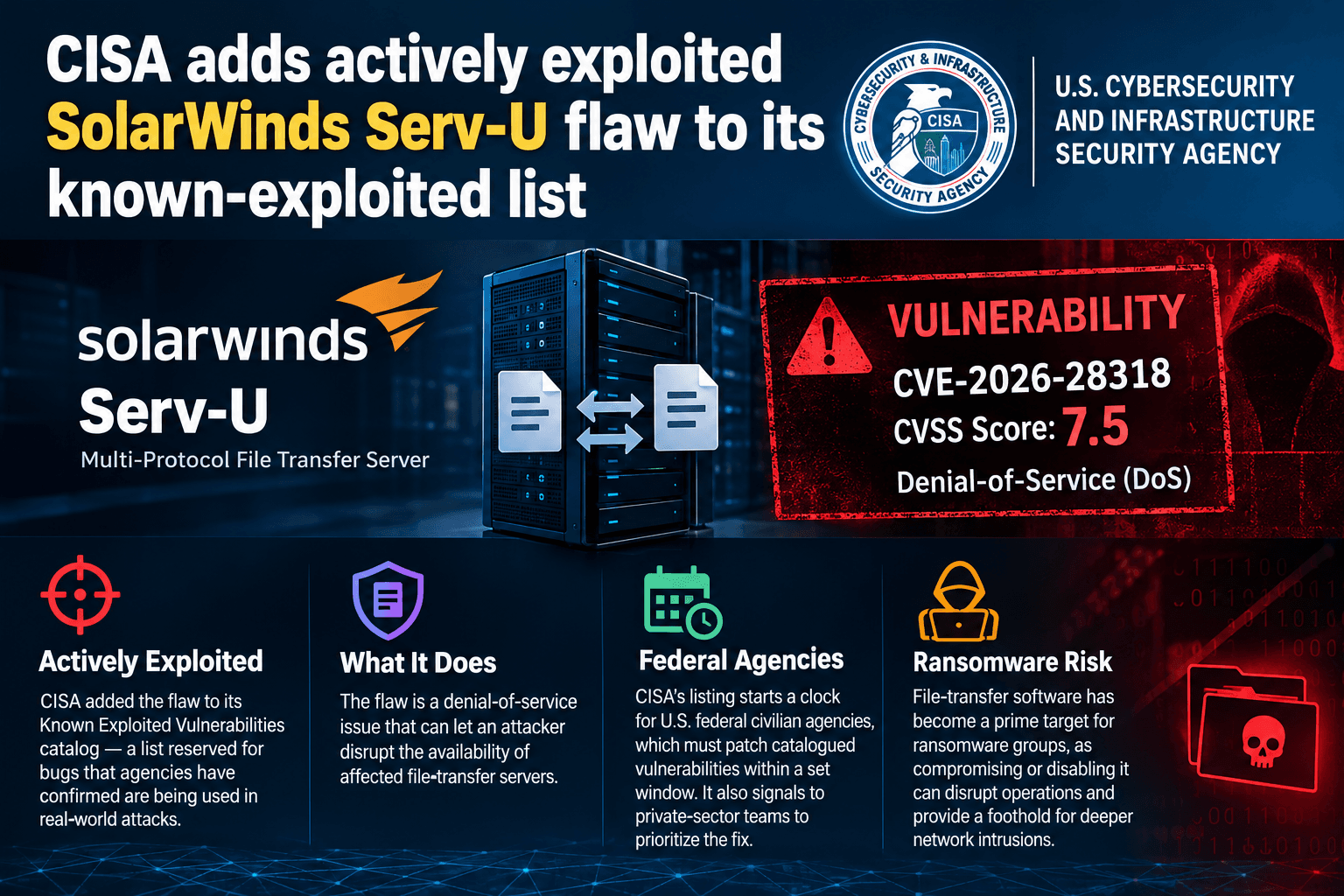
On June 5, 2026, the US Cybersecurity and Infrastructure Security Agency added CVE-2026-28318 to its Known Exploited Vulnerabilities (KEV) catalog. The flaw affects SolarWinds Serv-U, a multi-protocol file transfer server, and carries a CVSS score of 7.5. Inclusion in the catalog means CISA has evidence of exploitation in real attacks.
The vulnerability
The bug is a denial-of-service issue caused by uncontrolled resource consumption. According to SolarWinds, an attacker can send specially crafted POST requests that use the Content-Encoding: deflate header and crash the Serv-U service. No authentication is needed. It does not give access to files, but it can take a file-transfer server offline, which matters for companies that exchange data with partners on a schedule.
Public reporting had few details about who is exploiting it, how, or how many internet-facing servers were hit. Some third-party blogs claimed public proof-of-concept code existed while others said none had been released, so that point is unverified.
Fix and workarounds
- Fixed version: Serv-U 15.5.4 Hotfix 1. Sources differ on whether it shipped on June 3 or June 5.
- Interim mitigations: limit access to known addresses, and block requests that include a content-encoding header, since the vulnerable feature is not normally needed.
The federal deadline
Under Binding Operational Directive 22-01, Federal Civilian Executive Branch agencies had to remediate the flaw by June 19, 2026. Private organizations are not bound by the directive, but the KEV list is widely used as a patch-priority signal.
Why file-transfer servers matter
Earlier Serv-U flaws have been exploited by threat actors, including groups linked to the Cl0p ransomware gang, in 2021, 2022 and 2024. Even a plain denial-of-service bug is worth patching quickly on a product with that history, because attackers may combine it with other techniques or use it to disrupt operations.
For another KEV-style patching story, see our report on an exploited Cisco SD-WAN flaw.
Advertisement