
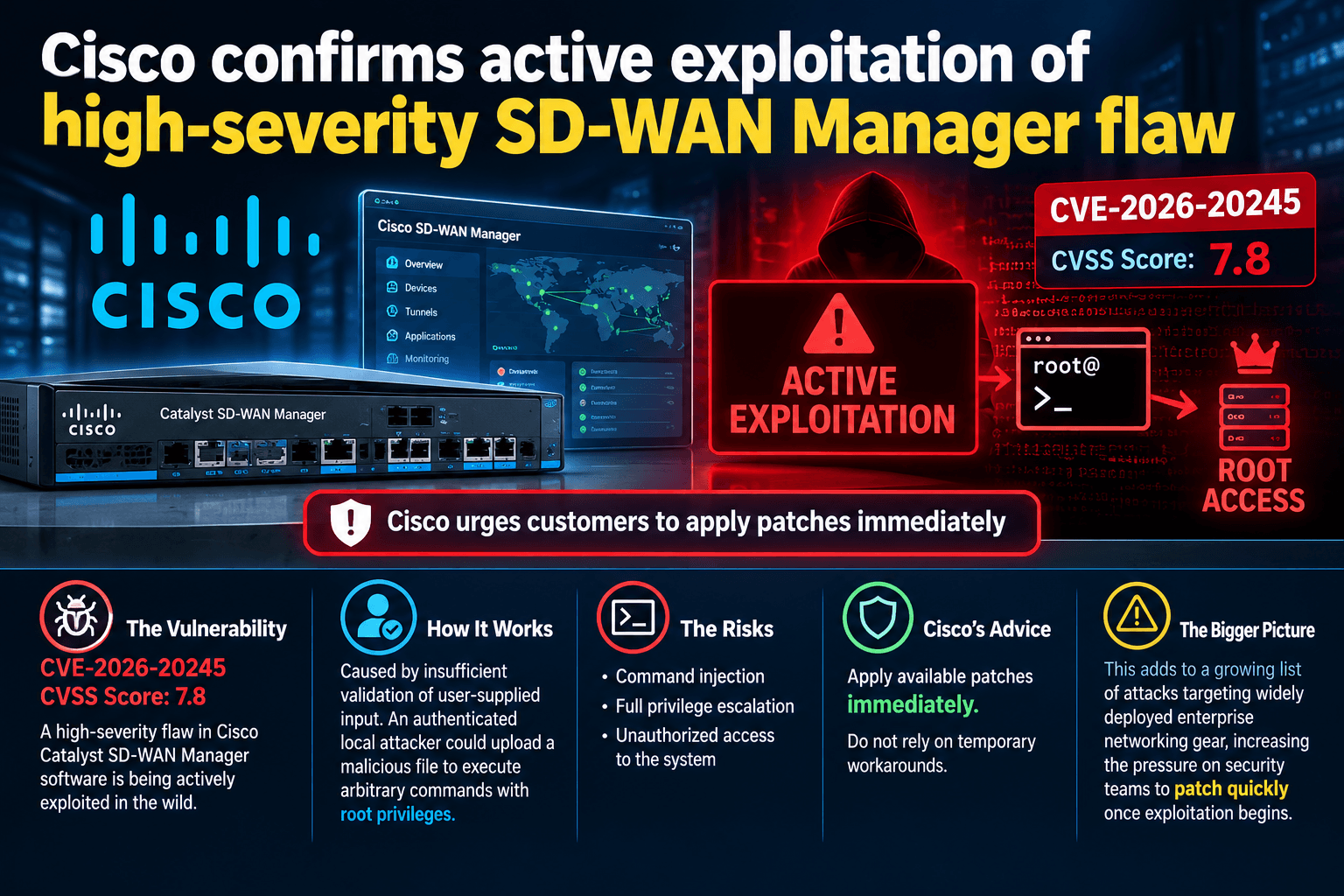
Cisco confirms active exploitation of high-severity SD-WAN Manager flaw
The flaw
Cisco disclosed CVE-2026-20245, a command-injection and privilege-escalation flaw in the command-line interface of Cisco Catalyst SD-WAN Manager. It has a CVSS score of 7.8, which is rated high. Because of insufficient validation of user-supplied input, an attacker who uploads a specially crafted file can run arbitrary commands as root on the system.
Who can exploit it
The attacker needs local, authenticated access with netadmin privileges. That sounds limiting, but Cisco noted that an attacker can obtain those privileges with valid credentials or by chaining the flaw with two earlier SD-WAN bugs, CVE-2026-20182 and CVE-2026-20127. Cisco said it knew of no other route. All deployment types are affected: on-premises, Cisco-managed cloud, Cloud-Pro and the FedRAMP government version.
Exploitation seen in the wild
Cisco observed limited cases in which exploitation led to configuration changes being pushed to edge devices. Mandiant researchers are credited with reporting the issue, and later write-ups from Mandiant said attackers had used it earlier in 2026, before the public advisory. One researcher write-up described a malicious CSV file used to create a new root account. Reports did not agree on which threat group was responsible, so treat attribution with care. CISA reportedly added the flaw to its Known Exploited Vulnerabilities catalog days after disclosure. It is the seventh Cisco SD-WAN flaw flagged as exploited in 2026.
Patch status
Early coverage on June 5 said Cisco was still working on patches and that no workarounds existed. Fixed software was released shortly afterwards, with updates reported from June 10 to June 12. Examples include 20.9.9.2, 20.12.7.2, 20.15.4.5, 20.15.5.3, 20.18.3.1 and 26.1.1.2. Confirm the right fixed release for your train in Cisco's advisory.
What defenders should do
- Run the admin-tech command on each control component to preserve evidence before upgrading.
- Check
/var/log/scripts.logfor suspicious entries that mention uploaded CSV files. - Upgrade to a fixed release.
- If you find signs of compromise, an update alone is not enough. Open a case with Cisco TAC for remediation.
Cisco also changed how it publishes advisories, which we cover in our story on its AI-era disclosure schedule.
Advertisement