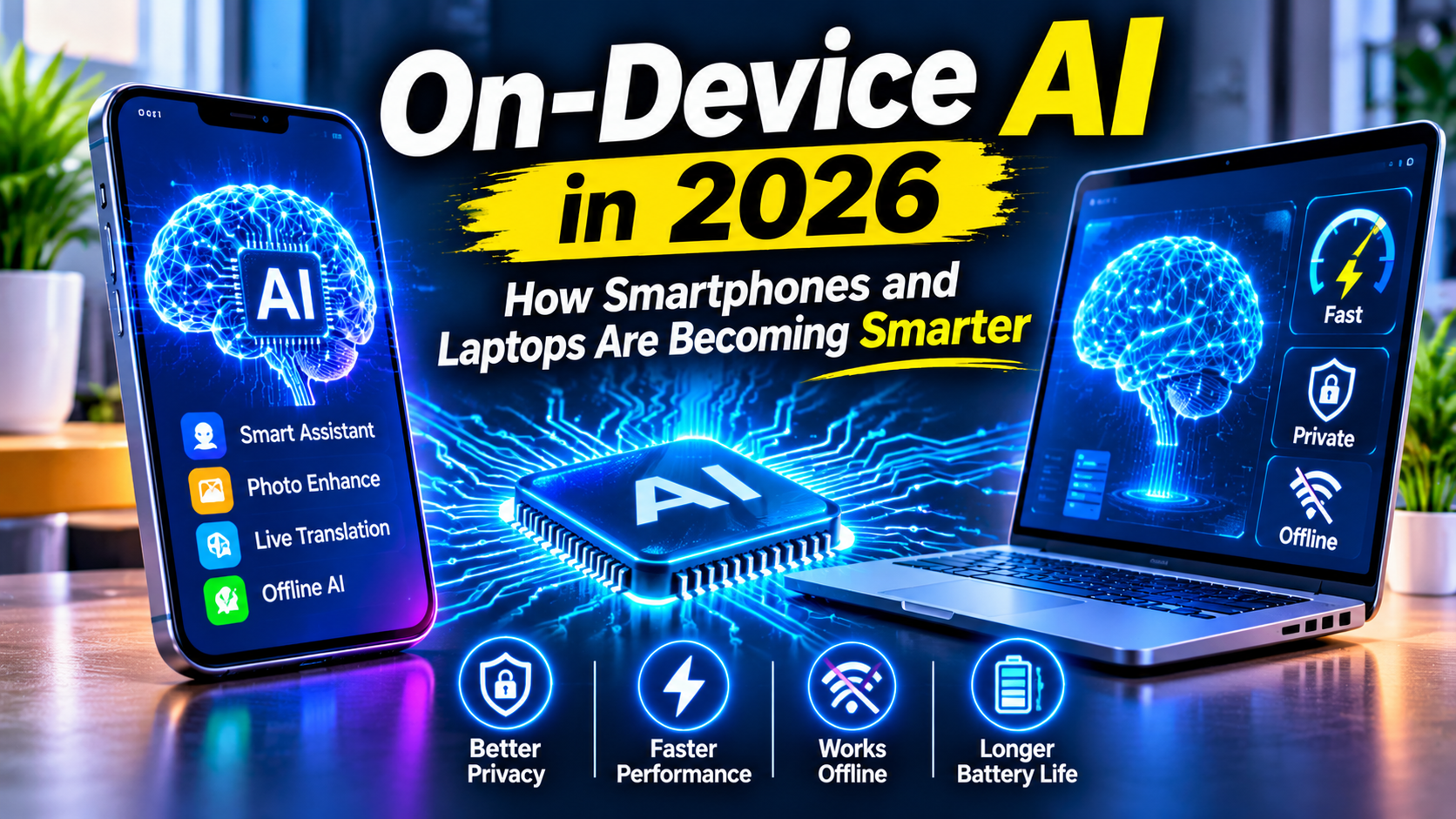
On-Device AI in 2026: How Smartphones and Laptops Are Becoming Smarter
On-Device AI in 2026: How Smartphones and Laptops Are Becoming Smarter
Artificial intelligence is increasingly becoming part of everyday devices. Features such as voice recognition, photo editing, text summarisation and smart assistants are changing how people use smartphones and computers.
Traditionally, many AI applications depended on powerful remote servers. However, on-device AI is making it possible to run certain AI tasks directly on a user's device.
What Is On-Device AI?
On-device AI refers to artificial intelligence processing that takes place locally on hardware such as a smartphone, laptop, tablet or smart device.
Instead of sending every request to a remote server, the device processes supported tasks using its own processor, graphics hardware or specialised AI accelerator.
Small and optimised AI models make this approach possible.
How Does On-Device AI Work?
Developers prepare AI models to run efficiently on devices with limited computing resources.
This may involve:
Reducing model size.
Quantising model weights.
Optimising calculations.
Using specialised neural processing hardware.
Managing memory and battery consumption.
The goal is to deliver useful AI features without requiring the same computing power as a large cloud-based system.
Everyday Uses of On-Device AI
Smart Photography
AI can help improve images, recognise scenes, remove unwanted objects and adjust camera settings.
Voice Recognition
Devices can process supported voice commands and speech-to-text tasks locally.
Writing Assistance
Some devices offer text suggestions, grammar support and summarisation features.
Offline AI Features
Certain AI functions may continue working without an internet connection, depending on the model and device.
Benefits of On-Device AI
Privacy: Data can remain on the device for supported tasks, reducing the need to transmit it to remote services.
Speed: Local processing can reduce network delays.
Offline access: Some features can work without an internet connection.
Cost control: Local inference can reduce reliance on cloud processing for frequently used tasks.
What Are the Limitations?
On-device AI still faces hardware limitations. Large models can require significant memory, processing power and storage.
Running AI continuously may also consume battery power and increase device temperature.
Cloud-based systems remain useful for tasks that require larger models or more computing resources.
On-Device AI vs Cloud AI
On-device AI processes supported tasks locally, while cloud AI sends requests to remote infrastructure.
Neither approach is always better. Local processing can offer privacy and convenience, while cloud services can provide access to more powerful models.
Many future applications are likely to combine both approaches.
Final Thoughts
On-device AI is making artificial intelligence more accessible through everyday hardware.
As processors become more efficient and AI models become better optimised, smartphones and laptops may handle an increasing number of intelligent tasks locally.
Advertisement